Sunday, January 20, 2019

Cornerstone Class: 1 Thessalonians 5:1-11


Cornerstone Class Outline for 1/20/19—Tom Nash

·         Announcements, praises and prayer requests—Joe Kerns

·         Hand out map of Paul’s second missionary journey and give context using Acts 17:

o   I found this map of Paul’s second missionary journey on the Blue Letter Bible website. You can find maps like this in the backs of your Bibles, but I liked this one because of the nice descriptions of his journey below the map.

o   I’d like to spend a couple of minutes going through this as a review to give us some context to 1 Thessalonians.
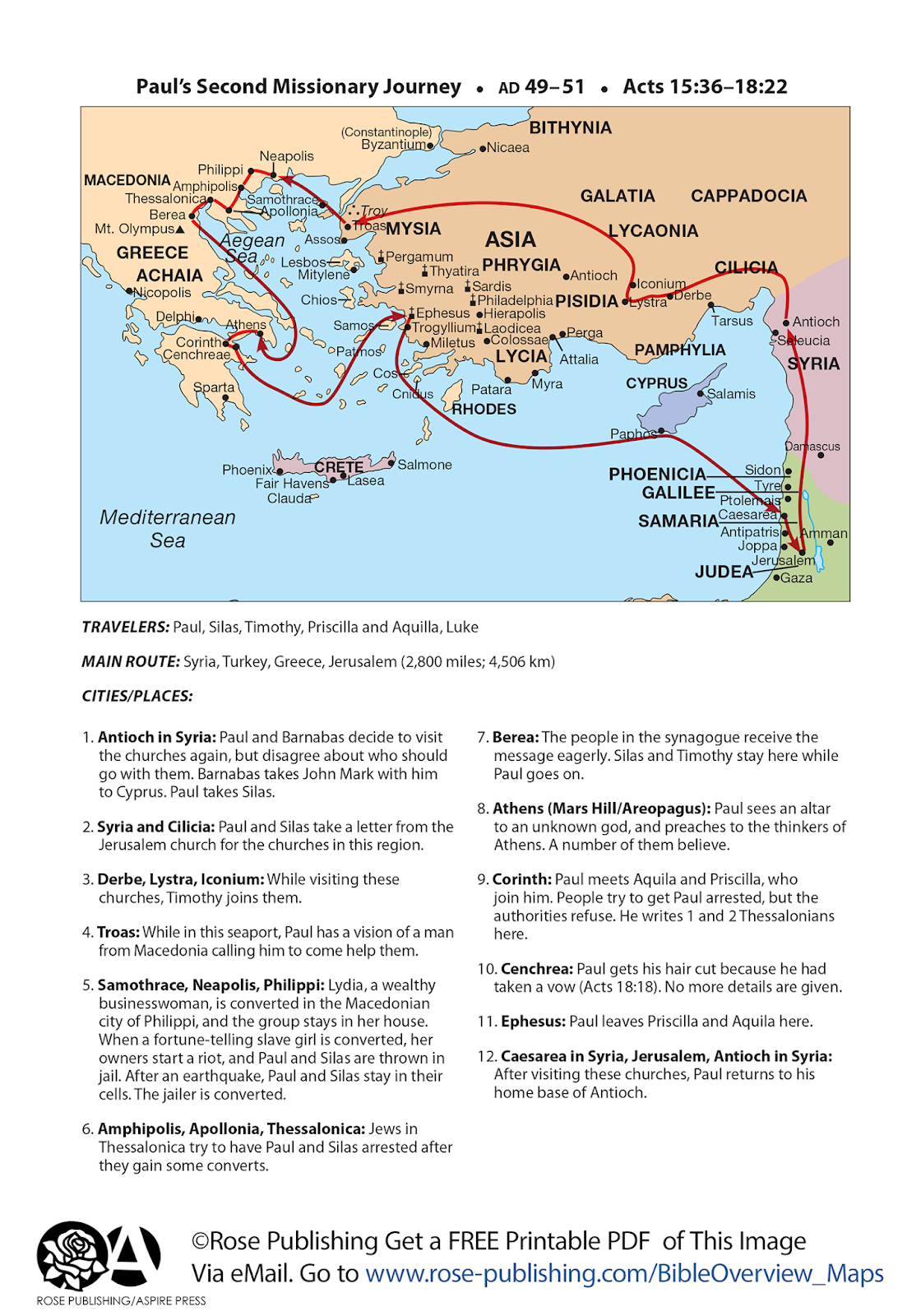
o   Paul started in Antioch and travelled through Asia Minor (modern-day Turkey)

o   He crosses the Aegean Sea into Macedonia, eventually ending up in Thessalonica.

o   I’d like to read a few passages from Acts 17 that describe the founding of the church in Thessalonica

o   Acts 17:1-3

“1 When Paul and his companions had passed through Amphipolis and Apollonia, they came to Thessalonica, where there was a Jewish synagogue. 2 As was his custom, Paul went into the synagogue, and on three Sabbath days he reasoned with them from the Scriptures, 3 explaining and proving that the Messiah had to suffer and rise from the dead. “This Jesus I am proclaiming to you is the Messiah,” he said. 4 Some of the Jews were persuaded and joined Paul and Silas, as did a large number of God-fearing Greeks and quite a few prominent women.

§  Paul spent at least 3 weeks in Thessalonica teaching about the Messiah

§  Some Jews believed, as well as a large number of Gentiles and prominent women
Purchase Mornings with Larry at: 
https://www.amazon.com/dp/B07HNQKB1L


o   Acts 17:4-10

“5 But other Jews were jealous; so they rounded up some bad characters from the marketplace, formed a mob and started a riot in the city. They rushed to Jason’s house in search of Paul and Silas in order to bring them out to the crowd. 6 But when they did not find them, they dragged Jason and some other believers before the city officials, shouting: “These men who have caused trouble all over the world have now come here, 7 and Jason has welcomed them into his house. They are all defying Caesar’s decrees, saying that there is another king, one called Jesus.” 8 When they heard this, the crowd and the city officials were thrown into turmoil. 9 Then they made Jason and the others post bond and let them go.

“10 As soon as it was night, the believers sent Paul and Silas away to Berea. On arriving there, they went to the Jewish synagogue.”

§  Essentially, the Jews and city officials chased Paul out of town

§  Also, this describes the harsh environment that the new Thessalonian believers had to live in. We know they were a persecuted church, which is why much of 1 Thessalonians is full of encouragement from Paul.

o   From Berea, Paul traveled to Athens, then Corinth

o   In Corinth he wrote 1 and 2 Thessalonians in about 51 AD

o   By the way, 1 and 2 Thessalonians were Paul’s first canonical letters

o   I think by seeing Paul’s travels on a map, it gives us some context that helps us to better understand the details of scripture.

·         Discussion. Let’s start with 1 Thessalonians 5:1-3 NIV:

“1 Now, brothers and sisters, about times and dates we do not need to write to you, 2 for you know very well that the day of the Lord will come like a thief in the night. 3 While people are saying, “Peace and safety,” destruction will come on them suddenly, as labor pains on a pregnant woman, and they will not escape.

·         Questions on 1 Thes. 5:1-3 NIV:

o   What does Paul mean in verse 1 when where he states “about times and dates we do not need to write to you.”?

·         Answer: it’s a figure of speech meaning no one knows when the day of the Lord will happen.

·         Also, he may have explained these things to them on his original visit.

o   In verse two, what is the day of the Lord?

·         Possible answer: In the OT, the day of the Lord was often used to describe the judgment of God in the last days (Amos 5:18).

·         In the NT the day of the Lord encompasses the second coming of Christ, the resurrection, eternal life and blessing for believers, judgment for unbelievers. The great tribulation could be included.

o   Why does Paul use the simile “the day of the Lord will come like a thief in the night.”?

·         Answer: it will be a bad surprise for unbelievers

o   What is the sudden destruction in verse 3?

·         Possible answer: The word destruction is also in 2 Thessalonians 1:6-9 NIV “6 God is just: He will pay back trouble to those who trouble you 7 and give relief to you who are troubled, and to us as well. This will happen when the Lord Jesus is revealed from heaven in blazing fire with his powerful angels. 8 He will punish those who do not know God and do not obey the gospel of our Lord Jesus. 9 They will be punished with everlasting destruction and shut out from the presence of the Lord and from the glory of his might….” 

·         Let’s continue on and read 1 Thessalonians 5:4-8 NIV:

“4 But you, brothers and sisters, are not in darkness so that this day should surprise you like a thief. 5 You are all children of the light and children of the day. We do not belong to the night or to the darkness. 6 So then, let us not be like others, who are asleep, but let us be awake and sober. 7 For those who sleep, sleep at night, and those who get drunk, get drunk at night. 8 But since we belong to the day, let us be sober, putting on faith and love as a breastplate, and the hope of salvation as a helmet.”

·         Questions on 1 Thessalonians 5:4-8 NIV:

o   In verse 4, Paul says that the day of the Lord shouldn’t surprise the Thessalonian believers like a thief. Why shouldn’t they be surprised?

·         Possible answers: they are children of light and day.

o   In verses 6-8, Paul exhorts the Thessalonian believers to be awake and sober, and to put on faith, love and the hope of salvation. Why is Paul exhorting them? Is it possible that some Christians will be caught off guard on the day of the Lord?

·         Possible answer: lukewarm Christians who don’t know the scriptures will be surprised on the day of the Lord

·         Let’s read 1 Thessalonians 5:9-11 NIV:

“9 For God did not appoint us to suffer wrath but to receive salvation through our Lord Jesus Christ. 10 He died for us so that, whether we are awake or asleep, we may live together with him. 11 Therefore encourage one another and build each other up, just as in fact you are doing.”

·         Questions on 1 Thessalonians 5:9-11 NIV:

o   Based on verses 9-10, what is the destiny of believers on the day of the Lord?

o   With our ultimate hope in mind, what does verse 11 tell us to do?

·         Encourage and built each other up

·         Concluding comments:

o   In the last few weeks, we’ve covered two sections of prophecy in 1 Thessalonians. Both sections conclude in a similar way.

o  In the first section, 1 Thessalonians 4:13-18, verse 18 says, “Therefore encourage one another with these words.”

o   In the second section, 1 Thessalonians 5:1-11, verse 11 says, “Therefore encourage one another and build each other up, just as in fact you are doing.”

o   The Thessalonians were a young, persecuted church in need of encouragement. Paul wrote about the second coming and resurrection to give these new Christians hope that they would be saved and have eternal life.

o   They needed this hope to endure the difficulties of their present life.

o   So Paul exhorted them to encourage one another and build each other up.

o   Likewise, we are to encourage and build up each other by keeping in mind the incredible blessings that await us when Jesus returns.

·         We’ll receive our resurrection bodies

·         We’ll spend eternity in the perfect presence of the Lord. No more seeing through a glass darkly.
·         Closing prayer

* * *

Nazarene Articles of Faith concerning the second coming, the resurrection, judgment, and eternity:

XV. Second Coming of Christ

15. We believe that the Lord Jesus Christ will come again; that we who are alive at His coming shall not precede them that are asleep in Christ Jesus; but that, if we are abiding in Him, we shall be caught up with the risen saints to meet the Lord in the air, so that we shall ever be with the Lord.

(Matthew 25:31-46; John 14:1-3; Acts 1:9-11; Philippians 3:20-21; 1 Thessa­lonians 4:13-18; Titus 2:11-14; Hebrews 9:26-28; 2 Peter 3:3-15; Revelation 1:7-8; 22:7-20)

XVI. Resurrection, Judgment, and Destiny

16. We believe in the resurrection of the dead, that the bod­ies both of the just and of the unjust shall be raised to life and united with their spirits—“they that have done good, unto the resurrection of life; and they that have done evil, unto the resurrection of damnation.”

16.1. We believe in future judgment in which every person shall appear before God to be judged according to his or her deeds in this life.

16.2. We believe that glorious and everlasting life is assured to all who savingly believe in, and obediently follow, Jesus Christ our Lord; and that the finally impenitent shall suffer eternally in hell.

(Genesis 18:25; 1 Samuel 2:10; Psalm 50:6; Isaiah 26:19; Daniel 12:2-3; Mat­thew 25:31-46; Mark 9:43-48; Luke 16:19-31; 20:27-38; John 3:16-18; 5:25-29; 11:21-27; Acts 17:30-31; Romans 2:1-16; 14:7-12; 1 Corinthians 15:12-58


Cornerstone Class: 1 Thessalonians 4:15-18


Cornerstone Class Outline for 1/13/19
1 Thessalonians 4:15-18

·         Prayer requests—Vicki Kerns

·         Jody Angier introduces Tom
Purchase Mornings with Larry at: 
https://www.amazon.com/dp/B07HNQKB1L

·       Who I am in Christ:

·         Jody explained what I do. I’d like to spend 3-4 minutes describing who I am in Christ. I might add that this also describes who you are. Everyday, I pray these four truths to God to remind myself of my identity in Christ.

1.      First, I am loved by God

·         1 John 4:9-10 NIV says, “9 This is how God showed his love among us: He sent his one and only Son into the world that we might live through him. 10 This is love: not that we loved God, but that he loved us and sent his Son as an atoning sacrifice for our sins.”

·         The greatest expression of God’s love is that he sent Jesus to die on the cross for our sins

2.      Second, I am completely forgiven and justified—in right standing before God

·         Romans 3:21-22 NIV says, “21 But now apart from the law the righteousness of God has been made known, to which the Law and the Prophets testify. 22 This righteousness is given through faith in Jesus Christ to all who believe.”

·         There’s an old saying that states, “All my sin was imputed to Christ. All his righteousness was imputed to me.”

·         God is pleased with me, not based on my own righteousness, but because of Christ’s righteousness imputed to me.

3.      Third, God accepts me as I am

·         Romans 5:10 NIV says, “For if, while we were God’s enemies, we were reconciled to him through the death of his Son, how much more, having been reconciled, shall we be saved through his life!”

·         I am no longer God’s enemy. I’m now His friend, thanks to Jesus’ death and resurrection.

·         John 15:14-15 NIV says, “14 You are my friends if you do what I command. 15 I no longer call you servants, because a servant does not know his master’s business. Instead, I have called you friends, for everything that I learned from my Father I have made known to you.”

·         Of course, this friendship is an unequal relationship. God is the heavenly Father and we are His created children.

4.      Fourth, I am born again; my heart has been regenerated

·         2 Corinthians 5:17 NIV says, “Therefore, if anyone is in Christ, he is a new creation; the old has gone, the new has come!”

·         Because God regenerated my heart, my life has been transformed and I am being transformed by the Holy Spirit.

That’s me in a nutshell! Let’s discuss 1 Thessalonians.

·         Discussion:

·         I love discussion because:
o   It gets us in the practice of talking about the Bible and spiritual things. We need to move beyond small talk and intentional discussion helps accomplish that.
o   God wants us to learn how to express what we believe and discussion groups help accomplish that goal.
o   By discussing Biblical truth with each other, it may help us to better share Christ with unbelievers.

·         Today’s scripture: 1 Thessalonians 4:15-18 NIV: “15 According to the Lord’s word, we tell you that we who are still alive, who are left until the coming of the Lord, will certainly not precede those who have fallen asleep. 16 For the Lord himself will come down from heaven, with a loud command, with the voice of the archangel and with the trumpet call of God, and the dead in Christ will rise first. 17 After that, we who are still alive and are left will be caught up together with them in the clouds to meet the Lord in the air. And so we will be with the Lord forever. 18 Therefore encourage one another with these words.”
·         Riddle: The three most common camps of end-times theology are premillennialism, amillennialism, and postmillennialism. There is a third less common view called panmillennialism. Can someone explain panmillennialism in one sentence? Answer: It will all pan out in the end.
·         Opening question:

o   Mark Kelly suggested that I start off with a provocative question, so here goes: Let’s say we have two people with conflicting views of the last days. Is it possible for them to discuss end-times theology without hard feelings? If so, what attitude should they have that will promote peaceful fellowship in Christ?

o   Answer: Evangelical scholar Robert Lightner wrote, “I want to suggest that evangelicals begin to practice in their use of prophecy what they preach in their doctrine of the family of God. It is time that we start behaving like brothers and sisters in the heavenly family. Each child in the household of faith is needed, and we must never forget that the exercise of Christian love is just as essential in eschatology as it is in every other area of God’s truth and Christian living.”

o   When discussing prophecy, what are two attitudes that Dr. Lightner recommends? Answer: view each other as valued members of God’s family. Practice Christian love.
·         Questions on 1 Thes. 4:15-18:
o   In verse 15, what does Paul mean when he states that those who are alive won’t precede those who are asleep? (answer in verse 16) The dead in Christ will rise first.

o   Is verse 16 to be taken literally—that Jesus will come down from heaven with a loud command, the voice of the archangel and a trumpet call?

o   Is verse 17 describing the resurrection, the rapture or both?

o   Do you think that we’re going to continue up to heaven with Jesus, or will He proceed to land on the earth with us joining Him? Answer: this position implies a post-tribulation rapture—that the second coming and the rapture are the same thing.

o   Verse 18 says, “Therefore encourage one another with these words.” Why is the preceding description of the resurrection/rapture encouraging to the Thessalonians and us?

o   Why do you think Paul describes the dead in Christ as “those who have fallen asleep?”

o   As believers, where do our spirits go when we die?

o   When the dead in Christ rise, just what part of them is rising?

o   How does the fact of our future resurrection affect our current thinking as well as how we live our lives?
* * * 

Nazarene Articles of Faith concerning the second coming, the resurrection, judgment, and eternity:

XV. Second Coming of Christ

15. We believe that the Lord Jesus Christ will come again; that we who are alive at His coming shall not precede them that are asleep in Christ Jesus; but that, if we are abiding in Him, we shall be caught up with the risen saints to meet the Lord in the air, so that we shall ever be with the Lord.

(Matthew 25:31-46; John 14:1-3; Acts 1:9-11; Philippians 3:20-21; 1 Thessa­lonians 4:13-18; Titus 2:11-14; Hebrews 9:26-28; 2 Peter 3:3-15; Revelation 1:7-8; 22:7-20)

XVI. Resurrection, Judgment, and Destiny

16. We believe in the resurrection of the dead, that the bod­ies both of the just and of the unjust shall be raised to life and united with their spirits—“they that have done good, unto the resurrection of life; and they that have done evil, unto the resurrection of damnation.”

16.1. We believe in future judgment in which every person shall appear before God to be judged according to his or her deeds in this life.

16.2. We believe that glorious and everlasting life is assured to all who savingly believe in, and obediently follow, Jesus Christ our Lord; and that the finally impenitent shall suffer eternally in hell.

(Genesis 18:25; 1 Samuel 2:10; Psalm 50:6; Isaiah 26:19; Daniel 12:2-3; Mat­thew 25:31-46; Mark 9:43-48; Luke 16:19-31; 20:27-38; John 3:16-18; 5:25-29; 11:21-27; Acts 17:30-31; Romans 2:1-16; 14:7-12; 1 Corinthians 15:12-58


Saturday, December 15, 2018

Christian Hypocrites are Nothing New

Christian hypocrisy is a big stumbling block for both unbelievers and believers. When Christians, especially those in leadership positions, put on a show of holiness, then fail to live up to that show, it causes damage. It turns off unbelievers and can cause weak Christians to give up the faith.
Purchase Mornings with Larry at: 
https://www.amazon.com/dp/B07HNQKB1L

Skeptics or critics of the faith would say that Christian hypocrisy is strong evidence that Christianity doesn't work, and therefore isn't true. But I say that Christianity does work and is in fact true, despite the significant moral failures of believers. In this post, I'll present a single defense for my assertion, though there are a number of reasons Christians are sometimes hypocritical. For example, I think God does empower Christians to live loving, holy lives, but that power doesn't come automatically. Sometimes we fail to do our part in the process. Our part is doable, but it takes conscious, persistent effort. But that's not what this blog post is about.

I want to focus on the fact that Christians have been hypocrites from day one, beginning on the day of Pentecost. This uncomfortable truth is clear from the scriptures. In fact, the failures of the first-century church are evidence that the New Testament is true. God made sure nothing was hidden or candy coated. The writers of the New Testament documents were not giving us some Utopian religion. Rather, they gave us the truth, with all its warts and blemishes.

The existence of hypocrisy in the church does not invalidate the Christian faith. Hypocrisy just is. Sure, it wounds the body of Christ when it occurs. It's especially hurtful to the body when a Christian leader falls. It causes many in the flock to stumble, and it deters many from coming to Christ. Though hypocrisy causes harm, it doesn't disprove the faith.

I'll follow the SOAP method of devotional Bible study to develop my argument.
  • S is for Scripture
  • O is for Observation
  • A is for Application
  • P is for Prayer
Scripture:  Revelation 2:12-17 ESV
"12 And to the angel of the church in Pergamum write: ‘The words of him who has the sharp two-edged sword.13 ‘I know where you dwell, where Satan’s throne is. Yet you hold fast my name, and you did not deny my faith even in the days of Antipas my faithful witness, who was killed among you, where Satan dwells. 14 But I have a few things against you: you have some there who hold the teaching of Balaam, who taught Balak to put a stumbling block before the sons of Israel, so that they might eat food sacrificed to idols and practice sexual immorality. 15 So also you have some who hold the teaching of the Nicolaitans. 16 Therefore repent. If not, I will come to you soon and war against them with the sword of my mouth. 17 He who has an ear, let him hear what the Spirit says to the churches."
Observation:
Five of the seven churches in Roman Asia (today's western Turkey) contained sinful flaws that needed rebuking. Smyrna and Philadelphia were free of rebuke. I'm using Pergamum as my example of a church that contained "some" hypocrites. Some held to the false teachings of Baalum and the Nicolaitans. The ESV notes say that the Nicolaitans "...were spreading sexual and spiritual infidelity at Pergamum."
So, the church at Pergamum had some hypocrites who practiced false teaching and participated in sexual sin. It was bad, it was rebuked and they needed to repent. This sin was simply a reality within that church, just as it's a reality in the 21st-century church. It doesn't disprove the Christian faith. It just is.
Though not mentioned in Revelation, the Corinthian church is famous for its dysfunction. In 1 Corinthians, Paul rebuked them for allowing sexual immorality (5:1-13 and 6:12-20), along with "division...and social snobbery (1:10 and 11:18)" [ESV notes]. At least one was getting drunk during the Lord's Supper (11:21).
Also, a quick read of the letters of Peter, John and James, reveals a church that needed a lot of correction. The early church had many flaws, and the founding apostles often pointed these flaws out. Sometimes we think that just because the apostles performed miracles, signs and wonders, that the church should have been perfect. But it was far from perfect. 
My point is that hypocrisy in the church is nothing new. It is a Biblical reality. It is not God's will, but God allows it to happen.
Application:
First, when we observe Christians succumbing to sin and hypocrisy, we shouldn't see it as invalidating the Christian faith. Yes, it hurts the body of Christ, but we just need to carry on. We shouldn't allow the failings of others to deter our own walk with the Lord. Similarly, when other Christians fall short of God's best, that's no excuse for us to do the same.
Second, we need to know that God promises to give us strength to live victorious lives. We shouldn't be discouraged by the failings of other Christians. Just because they fall into sin and hypocrisy, doesn't mean I have to. God will strengthen us. Ephesians 6:10-18 ESV says, "10 Finally, be strong in the Lord and in the strength of his might. 11 Put on the whole armor of God, that you may be able to stand against the schemes of the devil. 12 For we do not wrestle against flesh and blood, but against the rulers, against the authorities, against the cosmic powers over this present darkness, against the spiritual forces of evil in the heavenly places. 13 Therefore take up the whole armor of God, that you may be able to withstand in the evil day, and having done all, to stand firm. 14 Stand therefore, having fastened on the belt of truth, and having put on the breastplate of righteousness, 15 and, as shoes for your feet, having put on the readiness given by the gospel of peace. 16 In all circumstances take up the shield of faith, with which you can extinguish all the flaming darts of the evil one; 17 and take the helmet of salvation, and the sword of the Spirit, which is the word of God, 18 praying at all times in the Spirit, with all prayer and supplication. To that end keep alert with all perseverance, making supplication for all the saints...."
Next, we need to follow Biblical guidelines for dealing with sin in the church. The purpose of church discipline is to bring someone to repentance. James wrote, "19 My brothers, if anyone among you wanders from the truth and someone brings him back, 20 let him know that whoever brings back a sinner from his wandering will save his soul from death and will cover a multitude of sins." (James 5:19-20 ESV)
Prayer:
"Dear Lord, help us not to doubt our faith when we see a fellow Christian fall into sin. Help is to give wise answers to skeptics who incorrectly think that hypocrisy invalidates Christianity. Strengthen us to live lives that glorify you. And help our church leaders to humbly provide church discipline where needed. Amen."


Wednesday, December 5, 2018

All You Need is Love!

Purchase Mornings with Larry at: 
https://www.amazon.com/dp/B07HNQKB1L
Under the New Covenant, Christians should obey God's commandments. However, we're not under the law. How do New Covenant commandments differ from the commandments of the Old Covenant? I don't think this is an easy question to answer, but it's worth exploring using the SOAP method of Bible study.

  • S is for Scripture
  • O is for Observation
  • A is for Application
  • P is for Prayer
Scripture: 1 John 3:22-24 ESV
"22 and whatever we ask we receive from him, because we keep his commandments and do what pleases him. 23 And this is his commandment, that we believe in the name of his Son Jesus Christ and love one another, just as he has commanded us. 24 Whoever keeps his commandments abides in God, and God in him. And by this we know that he abides in us, by the Spirit whom he has given us."
Observation:
Verse 22 says that God will answer the prayers of those who keep His commands and do what pleases him. Verse 23 gives a single "dual" command of believing in Jesus and loving our fellow human beings. Verse 24 says we abide in Him by keeping His commandments.
What are the New Covenant commands? We know two--believing in Jesus and loving others. 
Romans 13:8-10 ESV says, "8 Owe no one anything, except to love each other, for the one who loves another has fulfilled the law. 9 For the commandments, “You shall not commit adultery, You shall not murder, You shall not steal, You shall not covet,” and any other commandment, are summed up in this word: “You shall love your neighbor as yourself.” 10 Love does no wrong to a neighbor; therefore love is the fulfilling of the law." 
This passage mentions four of the Ten Commandments as examples of how the law is fulfilled through loving our neighbor as we would want to be loved.
  • Question for the group: Is this Romans passage telling us that we can disregard the ten commandments as long as we love our neighbor?
Galatians 5:13-14 ESV says, "13 For you were called to freedom, brothers. Only do not use your freedom as an opportunity for the flesh, but through love serve one another. 14 For the whole law is fulfilled in one word: “You shall love your neighbor as yourself.”
  • Question for group: What is meant by "you were called to freedom...?" 
This passage echoes the Romans passage that the law is fulfilled by loving "your neighbor as yourself." Verse 13 mentions serving one another as something done through love.
Jesus said in John 14:21 ESV, "21 Whoever has my commandments and keeps them, he it is who loves me. And he who loves me will be loved by my Father, and I will love him and manifest myself to him.”
  • Question for the group: What are the commandments that Jesus is referring to?
Matthew 22:35-40 ESV says, "35 And one of them, a lawyer, asked him a question to test him. 36 “Teacher, which is the great commandment in the Law?” 37 And he said to him, “You shall love the Lord your God with all your heart and with all your soul and with all your mind. 38 This is the great and first commandment. 39 And a second is like it: You shall love your neighbor as yourself. 40 On these two commandments depend all the Law and the Prophets.”
  • Question for the group: What does verse 40 mean?
In answer to the question, "Are Christians under the 10 commandments?", John Piper answered plainly, "No. The Bible says we're not under the law." (from the Desiring God website, 2010)
Application:
I don't think we are under the Old Covenant law. James 2:8 ESV says, "8 If you really fulfill the royal law according to the Scripture, “You shall love your neighbor as yourself,” you are doing well." 
Love is defined in 1 Corinthians 13:4-7 NIV, "4 Love is patient, love is kind. It does not envy, it does not boast, it is not proud. 5 It does not dishonor others, it is not self-seeking, it is not easily angered, it keeps no record of wrongs. 6 Love does not delight in evil but rejoices with the truth. 7 It always protects, always trusts, always hopes, always perseveres." 
If we aim to follow this definition of love, then we are doing well, fulfilling the royal law.
Prayer:
"Dear Lord, help me to love and obey you--and to love my brothers and sisters in Christ. Thank you that your commands are not burdensome and that you empower us to love. In Jesus name, amen." 


Wednesday, November 28, 2018

The Rebuilt Temple under Cyrus and Darius

I love it when I feel motivated to do a SOAP devotional on Scripture from the Old Testament. I tend to gravitate toward New Testament passages because they seem to have more direct application to our lives. But the Old Testament applies to our lives as well; it just takes a bit more digging to find that application. Here's the SOAP acronym for personal Bible study:
Purchase Mornings with Larry at: 
https://www.amazon.com/dp/B07HNQKB1L

  • S for Scripture
  • O for Observation
  • A for Application
  • P for Prayer
Scripture:
Haggai 2:1-9 (ESV) 1 In the seventh month, on the twenty-first day of the month, the word of the LORD came by the hand of Haggai the prophet, 2 “Speak now to Zerubbabel the son of Shealtiel, governor of Judah, and to Joshua the son of Jehozadak, the high priest, and to all the remnant of the people, and say, 3 ‘Who is left among you who saw this house in its former glory? How do you see it now? Is it not as nothing in your eyes? 4 Yet now be strong, O Zerubbabel, declares the LORD. Be strong, O Joshua, son of Jehozadak, the high priest. Be strong, all you people of the land, declares the LORD. Work, for I am with you, declares the LORD of hosts, 5 according to the covenant that I made with you when you came out of Egypt. My Spirit remains in your midst. Fear not. 6 For thus says the LORD of hosts: Yet once more, in a little while, I will shake the heavens and the earth and the sea and the dry land. 7 And I will shake all nations, so that the treasures of all nations shall come in, and I will fill this house with glory, says the LORD of hosts. 8 The silver is mine, and the gold is mine, declares the LORD of hosts. 9 The latter glory of this house shall be greater than the former, says the LORD of hosts. And in this place I will give peace, declares the LORD of hosts.’”

Observation:

  • I was impacted by the fact that God's sovereign hand was on the rebuilding of the temple in Jerusalem. God's Spirit was evident because He sent the prophet Haggai to command Israel to continue rebuilding the temple. The work had all but ceased for 20 years due to local opposition to the rebuilding. Also, King Artaxerxes, who ruled Persia between Cyrus and Darius's reigns, commanded that the rebuilding cease in Jerusalem. Darius, after reading Cyrus's original decree, ordered that the rebuilding continue. (Ezra 6). So, the rebuilding continued in the second year of Darius' reign. The temple was completed in Darius's 6th year of reign.
  • So, we see how the secular authorities influenced the rebuilding of Jerusalem and the temple. But the prophecies of Haggai reveal that God was the ultimate authority behind the rebuilding. Also God undoubtedly controlled the hearts of Cyrus and probably Darius. Ezra 1:1-2 says, "1 In the first year of Cyrus king of Persia, that the word of the LORD by the mouth of Jeremiah might be fulfilled, the LORD stirred up the spirit of Cyrus king of Persia, so that he made a proclamation throughout all his kingdom and also put it in writing: 2 “Thus says Cyrus king of Persia: The LORD, the God of heaven, has given me all the kingdoms of the earth, and he has charged me to build him a house at Jerusalem, which is in Judah."
  • Haggai 2:9 says, "The latter glory of this house shall be greater than the former, says the LORD of hosts. And in this place I will give peace, declares the LORD of hosts.’” The NIV notes say this could be referring to Christ's physical appearance at the temple, the first time as a child (Luke 2:22-38) when his parents presented Him at the temple. Simeon prophesied over the Christ child, 29 “Lord, now you are letting your servant depart in peace, according to your word; 30 for my eyes have seen your salvation 31 that you have prepared in the presence of all peoples, 32 a light for revelation to the Gentiles,and for glory to your people Israel.” (Luke 2:29-32)
  • The ESV notes mention God's "latter glory of this house" as possibly tied to the New Covenant church, who are the temple of the Holy Spirit.
Application:
  • As God's sovereign hand was on the rebuilding of the Jerusalem temple, his hand is committed to the rebuilding of our lives. Philippians 1:6 (ESV) says, "And I am sure of this, that he who began a good work in you will bring it to completion at the day of Jesus Christ."
  • As God promised that the latter glory of the temple would be greater than the former, the temple of the New Covenant church is the ultimate manifestation of the latter glory. 1 Cor. 3:16-17 (ESV) says, "16 Do you not know that you are God’s temple and that God’s Spirit dwells in you? 17 If anyone destroys God’s temple, God will destroy him. For God’s temple is holy, and you are that temple."  Eph.5:27 (KJV) says, "That he might present it to himself a glorious church, not having spot, or wrinkle, or any such thing; but that it should be holy and without blemish."
Prayer:
"Dear Lord, thank you for your sovereign hand on our lives and your commitment to the sanctification of your church. As your hand was on the rebuilding of the temple in Jerusalem, your hand is on the rebuilding of our lives. Help us to do our part in the rebuilding process. In Jesus name we pray, amen."

Sunday, November 25, 2018

Get Your Priorities Straight by Sowing Seeds

I've heard many sermons about the importance of putting Christ first in our lives. Concerning priorities, most Evangelical pastors would say God should be number one, family number two and perhaps our job/career number three. A recent Christianity Today article featured some findings from a recent Pew survey about family. Pew found that 42% of Christians (all protestants and Catholics) viewed family as the greatest source of meaning in their lives. 29% of these same Christians  found religion to be "their most important source of meaning." So, these results seem to indicate that most Christians find family more meaningful than God.
 Purchase Mornings with Larry at:
https://www.amazon.com/dp/B07HNQKB1L

Evangelical Christians fared better--45% placing their faith first, and 31% putting family first. Though we (yes, I'm an Evangelical) fared better than all combined Christians, we still fell short of Christ's words: "Whoever loves father or mother more than me is not worthy of me, and whoever loves son or daughter more than me is not worthy of me." (Matthew 10:37 ESV)

My purpose in this blog post isn't to heap condemnation on those Christians who lack passion for their Creator. Frankly, my passion for God can be weak at times. I think we can make God #1 in our lives--even during those times when we don't passionately experience Him. After all, we walk by faith, not by sight or feeling. So, putting God first requires that we take steps of faith.

With our physical eyes, we can see our families. We don't physically see God. We have to walk by faith in order to put Him first in our lives. What are some steps of faith we can take to place God first? All I can do is share what I do to make God my number one priority. I think God meets me with grace when I take rough steps of faith toward Him. When I take a step, he blesses me with more faith. Faith builds on faith. I take one step, then He enables me to take several more steps. It's kind of like seed faith. I sow a little seed and God causes it to sprout and grow into a large plant or tree.

I think the first seed is prayer. We need to talk to God regularly. If I feel spiritually weak, then I should ask God to fill me with His Holy Spirit. James wrote, "You do not have, because you do not ask." (James 4:2 ESV). If I've made other things number one in my life, then the first thing to do is make a prayer of confession, such as: "Lord, I confess I've been more passionate about politics (or family, sports, career, etc.) than you. Lord, help me to be most passionate about you. Thanks for forgiving me. Fill me with your Spirit so that you will be the most meaningful person in my life. Amen."

The next seed of faith would be meditating on Scripture daily. Psalm 119:11 (ESV) says, "I have stored up your word in my heart, that I might not sin against you." I think God's word is like a battery charger. I'm the battery that needs charged up daily. If I'm not regularly reading His word, then I get spiritually drained.

The next seed would be regular fellowship with other believers. This doesn't necessarily mean going to church every Sunday. It's possible (typical?) to attend church and not go beyond small talk. I attend church most Sundays and rarely get past small talk. The pathetic thing about this is that I'm bad at surface chit chat. Consequently, I don't mingle very well, and I look forward to the sermon so I don't have to invent fluffy conversation. I think clicks form in part because the small-talk experts gravitate towards other small-talk experts. Some are good at shooting the breeze, others aren't. It's not that clickish people are bad, they're simply going where it's comfortable.

It's important to have meaningful dialogue with other Christians. This means we should actually talk about the deep things of God. What are we learning from Scripture? What's the Lord teaching us? We need to share these things with our fellow believers. Small groups (that are dialogue-based) are much better at meeting this need. Small groups need to be intentional about focusing on meaningful dialogue. This may require that each member do a little preparation prior to the meeting, so they can have something other than surface talk to share.

Also, meeting with a strong Christian regularly, one-on-one, over coffee or tea (or a meal) is very beneficial. I meet with a friend every other week for a Christian book discussion. It's a "two-man book club." Of course, we talk about more than just the current book we're reading. These talks should also have some intentionality about them, or they could become only surface chit chat sessions. For me and my friend, the book discussion is the intentional thing.

Another "seed of faith" is receiving good teaching. God has provided gifted teachers within the body of Christ. All Christians need to receive good, Bible-based teaching on a regular basis. Good teaching can come through books, articles, videos, audios, Bible studies and sermons.

I'll mention a final seed of faith we can sow. We need to obey God. Please don't be intimidated by the word obedience. I see obedience as something that is a part of our progressive sanctification. As we grow in Christ, God reveals new areas where we need to change. This growth often means that we need to obey God in some part of our lives. Your area is typically different than mine. Jesus said, “If you love me, you will keep my commandments." (John 14:15 ESV). This isn't referring to the Old Testament law. Rather, there are numerous commands in the New Testament that God wants us to obey. But really, we can only obey God if we are first abiding in Him in a relationship. If we try to obey God apart from an abiding relationship with Him, we will fall on our face. We need the power of the Holy Spirit to obey God from the heart. One of my favorite verses is 2 Corinthians 12:9 (ESV), "But he said to me, 'My grace is sufficient for you, for my power is made perfect in weakness.' Therefore I will boast all the more gladly of my weaknesses, so that the power of Christ may rest upon me." I've found it true that God gives me strength when I recognize my weakness.

I'm sure there are other seeds of faith we should sow, but I'll finish with this: we should be diligent with the measure of faith God has given us. In other words, we should be faithful with the small things that God has revealed to us. If there's some easy little thing that I know God wants me to do--then I should do it. When I'm faithful with the small things, then God will entrust me with more. Blessings to you.