Friday, May 15, 2015

Israel Pilgrimage: Day Five

Our fifth day in Israel included a tour of the high-mountain-flat-top city of Masada, Ein Gedi (where David snipped King Saul's robe), Qumran (where the Dead Sea Scrolls were discovered), and our emotional entrance into Jerusalem.

Denise with that stranger again
First stop: Masada. This ancient city, fortress and palace first grabs your attention because of its location. It is built on the flat top of a high, steep mountain, overlooking the Dead Sea. Masada means “fortress.” Because of the near vertical, cliff-like sides of the mountain, Masada was nearly invulnerable to enemy attacks. Ancient Maccabean Jews began the fortifications, but starting in 35 B.C., Herod the Great gave Masada the full Roman treatment, lavishing it with two palaces, a throne room, thermal bathhouses, a swimming pool, army barracks, towers, porticos, a courtyard, reception hall, storehouses, terraces, servants rooms, and cisterns. In the 5th and 6th centuries, a Byzantine church occupied Masada.

Sunrise over Dead Sea
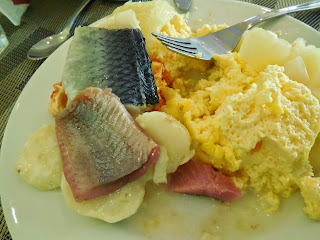
Pickled fish for breakfast
Buffets offer produce grown in Israel
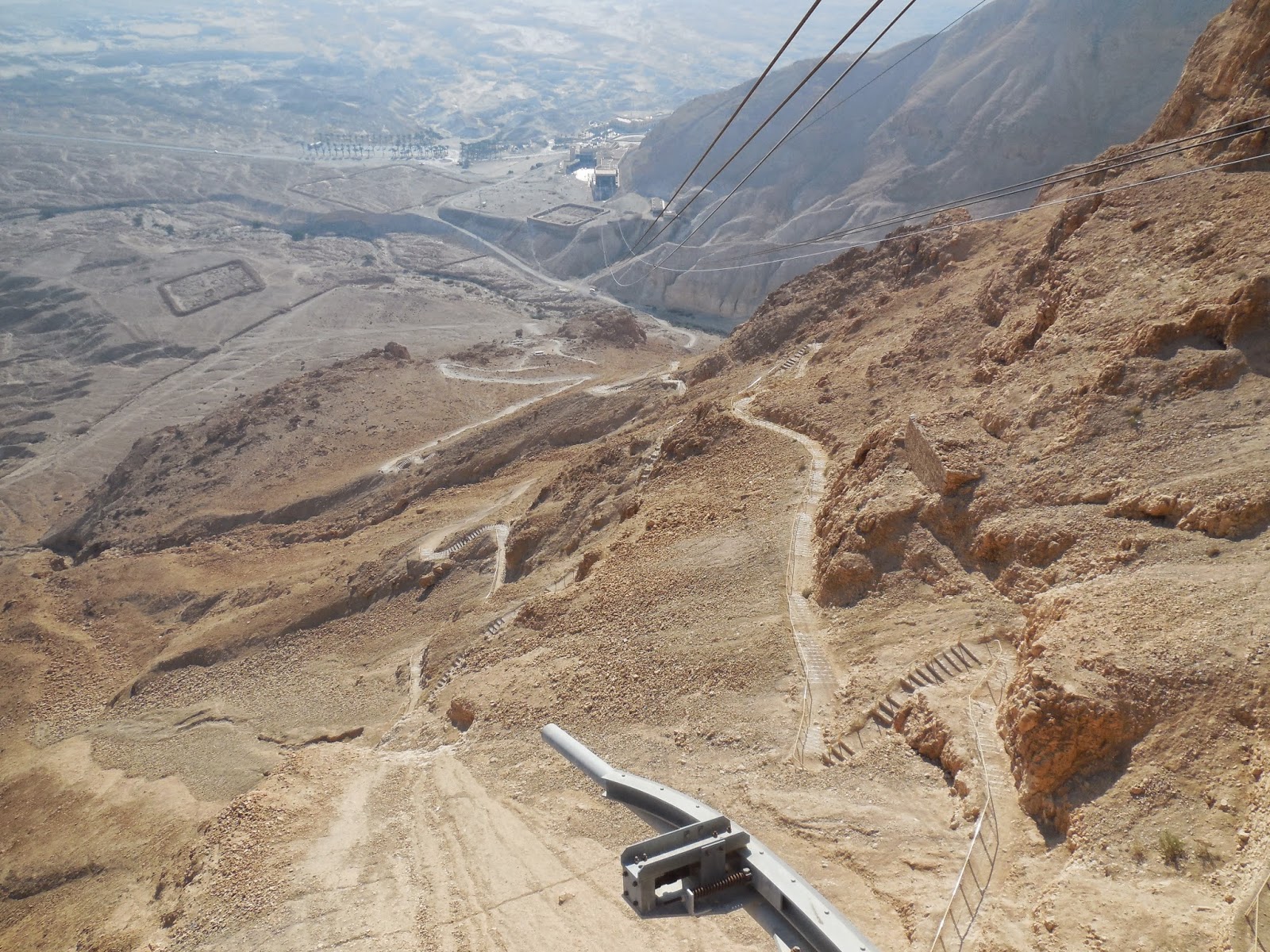
At the base of the mountain, we boarded a tram that took us to the top. The view was spectacular -- the Dead Sea far below us. A large military jet passed by below eye level. Tour guide, Harrison Cohen, pointed out square boundary lines in the desert valley below. Visualize "crop squares" rather than "crop circles." These were staging areas for the Roman armies as they prepared to take control of Masada from a die-hard and heroic group of Jews. After the destruction of Jerusalem by Rome in 70 A.D., a community of about 1000 Jewish rebels, called the “Zealots,” took control of Masada and held off the Roman army for over three years. In 73 A.D., the Zealots, along with their wives and children, committed mass suicide, rather than surrender to the overwhelming Roman forces. See the photo of the “breaching point,” where the Roman army built a huge dirt ramp that enabled them to move a battering ram up to the fortress wall.

Masada is a symbol for Israeli soldiers to fight to the end. In the high-walled ruins of a room near the outer wall, Pastor Glazner gave a short message about the Zealots’ willingness to die for their beliefs. Similarly, Christians need to die to self daily, in small areas as well as big. We must decrease, so the Lord can increase. (I'll insert my own take on the "die to yourself" doctrine based on the words of Jesus in the Gospels. It's not that we need to go looking for masochistic ways to punish ourselves and give up all pleasures in life. As all of you know, circumstances automatically enter our lives that force us to make decisions, either for good or for evil. Sometimes those decisions require "die-to-yourself" sacrifice. It's more about making right, sometimes hard, choices as we face day-to-day life. There's my sermon.)

Looking up at Masada and tram cables
The next stop was Ein Gedi, a beautiful desert oasis showcasing a stream cascading down a rocky hillside, lush with vegetation. Our group hiked up a steep trail alongside the stream. A lot of people were visiting Ein Gedi that day, including a large group of Israeli school girls, all in cerulean-blue uniforms. It was a strange sight to see them squealing with glee as they splashed in a pool under a small waterfall. It was an even stranger sight to see an armed body guard watching over them.

Literally, Ein (spring) Gedi (goat-kid), it is also known as the Spring of David. Ibex goats still roam the steep rocks there. Today, it is a scenic nature reserve and fresh-water oasis near the Dead Sea.
Denise and tour group on Masada tram

In the Bible, King Saul, out of jealousy, pursued David, then a popular young warrior, in the rocks and caves of Ein Gedi. David sneaked up behind Saul and cut off part of his robe. Later, David waved the cut portion at Saul and said, “For by the fact that I cut off the corner of your robe and did not kill you, you may know and see that there is no wrong or treason in my hands. I have not sinned against you, though you hunt my life to take it." (1 Samuel 24:11 ESV). I might add, this is the "actual" location mentioned in 1 Samuel. It was an exhilarating feeling knowing I scrambled along the same rocky terrain traversed by David and Saul.

Notice square Roman army staging area to left
Pastor Paul gave a short message that we should show restraint, like David, and trust God’s timing instead of taking things into our own hands.

We boarded the bus and drove to the Ahava Kibbutz factory, where we took a short tour. Ahava is world renown for its lotions and cosmetics containing healthy minerals from the Dead Sea. Ahava began as a simple kibbutz community. The members became wealthy as their product expanded worldwide.

Masada ruins high on mountain
We continued through the Dead Sea region and visited the ancient ruins of Qumran. The famous Dead Sea Scrolls were discovered in Qumran (from 1947 through early 1950’s) inside caves in the barren, rocky hillside. The scrolls had been preserved in jars for nearly 2000 years.

Archaeologists have also discovered, near the caves, the ruins of an ancient, all male, Jewish sect called the Essenes. They wore white robes, took frequent ritualistic baths, and had phylacteries (small boxes) just above their foreheads. It is believed that these were the scribes responsible for copying the scrolls. When the Romans destroyed Jerusalem in 70 A.D., it is thought that the Essenes, expecting an invasion, hid the scrolls in the surrounding caves. The Dead Sea Scrolls include books and fragments of the Hebrew Bible, Essene literature, commentaries, and most notably, an entire book of Isaiah that predates the previous oldest by about 1000 years.
Model of Herod's palace on Masada

Large military jet below eye level from top of Masada
A loose tradition, or myth, has it that John the Baptist spent time living with the Essenes. This makes sense, since he lived a similar austere lifestyle. He'd have fit right in. Maybe he got his idea for baptism from observing the continual religious baths taken by the Essenes. Who knows? Don't quote me.

Breaching point where Roman army overcame the Zealots
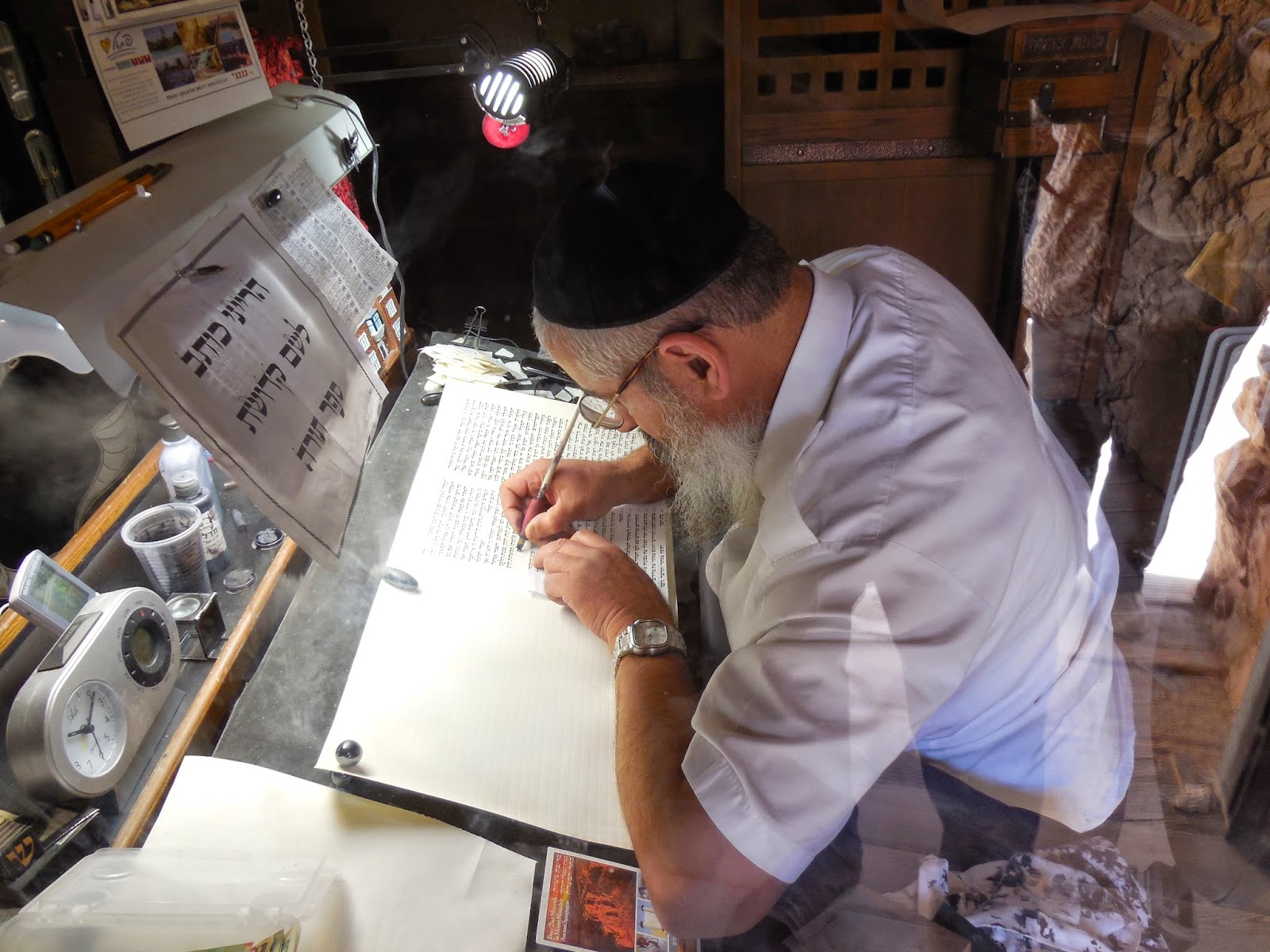
Scribe working at Masada. Why not?
The day would soon end on a literal high point with our entrance into Jerusalem. As the bus neared the high elevation of Jerusalem from the ultra-low elevation of the Dead Sea, we traveled through the Palestinian West Bank and noticed poor Bedouin shepherds tending livestock near tent-like shacks.

Speaking in the Volvo bus microphone, Paul Glazner read from Psalms 120-132, called Psalms of Ascent because ancient Hebrews had to ascend to the Holy City when journeying from afar. A little side note: whenever the Bible refers to "going up to Jerusalem," it doesn't mean traveling north. Whatever direction you travel from, you are always going "up" to Jerusalem.

Roman bath heating system
Roman bath area
Our tour bus stopped at a checkpoint, where we officially left the West Bank. We entered Jerusalem at 3:37 PM through a tunnel in the Mount of Olives. The bus parked high on Mount Scopus, the northern-most peak of the Mount of Olives range, overlooking the city. We got out and took in the panorama, looking beyond the Kidron Valley to the Old City of Jerusalem. The first thing that stopped my eye was the bright gold Dome of the Rock. It is the highest spot in Jerusalem, where the Jewish temple once stood, before the Romans destroyed it in 70 AD. Why is the Islamic Dome of the Rock there? We'll explore that issue on day seven.

Back to the tram. Goodbye Masada!
After several minutes of taking in the view, we boarded the bus and passed through modern Jerusalem en route to our hotel. While driving through the busy city, we noticed large numbers of Hasidic Jews walking the streets. They were dressed in black and sported those dangling side locks (payots) of hair where sideburns should be. Instead of wearing their normal black hats, the men wore big, round furry hats called shtreimels. A special event was taking place, most likely a wedding.

The day drew to a close as we settled into our hotel, ate another tasty buffet meal and contemplated the next day, which would include the garden of Gethsemane, a Palm Sunday walk down the Mt. of Olives, and an excursion to Bethlehem, where Christ was born.
Israeli school girls hiking up Ein Gedi
View of Dead Sea from Ein Gedi

I see teeth


Fun at Ein Gedi


Ruins of Essene community in Qumran


 Some Dead Sea scrolls found in this cave


Our first view of Jerusalem from Mt. Scopus

Hasidic Jews going to big Jerusalem wedding we thinks


On the move in Jerusalem

Friday, May 8, 2015

Israel Trip: Day Four

Day four in Israel includes a tour of the amazing Roman-style city, Beit She'an, a visit to the River Jordan and a body float in the salty Dead Sea. The Volvo bus took off from Galilee at 8 AM. As we headed south, our Renaissance man tour guide, Harrison Cohen, stood at the front of the bus and spoke into a mike. He got us started with a riddle: "What is the Jewish dilemma?" We scratched our heads and he answered, "Free pork."

Denise and the group inside 2nd century AD Roman-style theater in Beit She'an
Harrison summarized Israel's economy: high tech is #1, diamonds #2 and agriculture #3. Our bus passed through the Jezreel Valley (Valley of Armageddon), full of unending lush farmland. We experienced the benefits of Israel's high-tech agriculture; buffet meals included a large variety of fresh produce from these farms.

Red lines bus route. Green lines national borders.
In case you're wondering, Israel is a tiny country, just 290 miles long and 85 miles wide. We traveled as far south as the Dead Sea, so our tour was limited to the upper 2/3 of the country. It was no problem for the bus to cover much of Israel in a single day with plenty of time for stops.

We first stopped at Gideon's Cave and Harod Spring at the base of Mt. Gilboa. As told in the book of Judges, this is where God instructed Gideon to select his tiny army of 300, based on whether men lapped water like dogs or used their hands to drink. God insured Israel’s victory over the Midianites, who numbered in the thousands. The lesson is that God wants us to recognize our weaknesses, so that He can receive proper credit for victories in our lives. Harod Spring is located 20 miles south of Nazareth at the base of Mt. Gilboa. Many of the sites we visited in Israel were “traditional” locations of Biblical events, not necessarily “actual” locations. It's important to note that Harod Spring is considered authentic -- the actual spot mentioned in Judges 7:1-7.

Fresh produce from Israel's farms always in the buffets
Gideon's Cave and Harod Spring 
Our next stop was a surprising highlight of the trip: the ancient ruins of Beit She'an. An archaeological wonder, the levels of civilization unearthed in this city span from ancient Egyptian, Canaanite, Philistine, Greek, Roman, 6th century Byzantine, and 7th century Muslim Umayyads. During the Greco-Roman era, the city was called Nyssa Scythopolis. The expansive Roman ruins are amazingly preserved, including a theater, amphitheater, huge bathhouse and a wide central street flanked by massive columns. An earthquake in the 7th century destroyed much of the city, but large sections remained preserved.
Pastor Glazner demonstrates how Gideon's soldiers lapped like dogs

The city is mentioned a few times in the Bible. In 1 Kings 4:12, Solomon assigned an official over Beit She’an. Most notably, Beit She’an is where King Saul and his three sons met a grisly end, when the Philistines fastened their decapitated bodies “to the wall of Beth-shan.” (1Samual 31:8-10). Lesson learned? It’s wise to obey God.

Prickly tree bark near Gideon's Cave
We traveled farther south to a high point overlooking the Plains of Jordan. In the book of Joshua, this was the staging area where Israel camped, soon after crossing the Jordan River. Here, before conquering Jericho, God commanded all of Israel’s soldiers to be circumcised with flint stones gathered from these plains. As the men healed, they were vulnerable to their enemies. The lesson is that God puts us in vulnerable situations so that we must look to Him for deliverance and victory.

Each person in our group collected a flint stone off the ground as a memento. This was okay to do, because rocks and flint are quite plentiful in Israel.

Snazzy flower from same prickly tree
The River Jordan came next. It was a bit scary as our bus traveled several miles along a narrow road to the baptismal site. Scary because of the mine fields that flanked us on each side of the road. The Jordan River is the natural boundary separating Israel from the country of Jordan to the east. The river itself is not too impressive. It is murky and small, the size of a typical stream or large creek.

2nd century Roman-style ruins of Beit She'an
In the days of Moses, west-of-the-Jordan was the Promised Land -- Israel. When Joshua led the Israelites across the river, it marked the end of 40 years of wilderness wanderings and the start of a new era -- taking the Promised Land by force. Later, in the New Testament, John baptized Jesus in the Jordan, marking the start of the Lord’s ministry years.

The main street through ancient Beit She'an
We visited the Qaser El-Yahud baptismal site. Two young, armed soldiers, Nadil and Nadstoc, guarded the site. Curiously, just a few yards away, on the other side of the stream, was another baptismal site in the country of Jordan.

We had fun watching a large group of Russian Orthodox Christians, dressed in white robes, undergo a unique baptismal ritual. In unison, they all dunked in the river. When they surfaced, they cheered loudly. They repeated this a few times more. It was quite entertaining.

Roman mosaic tile in lower layer, Byzantine tile in upper layer
We arrived at the Dead Sea late in the afternoon, but not too late for a salt-water float. We tossed our luggage in our hotel rooms, slipped on swim suits, and trotted down to the sea. The air temperature was only in the 70's, so it took some nerve to enter the water. The number one rule is to not allow your head to get wet. High-saline/mineral water in the eyes is not good. Of course we bobbed like fishing floats. The proper body position is on the back, like a sea otter eating clams. Any inanimate objects projecting from the water were covered with thick layers of salt. Instead of a sandy shore, it was a salty shore.

The top (capital) of a Roman pillar
Public latrine in Beit She'an. Row of seats along right wall.
7,000-seat, 2nd century Roman theater
The Dead Sea's surface and shore are 1401 ft. below sea level -- the lowest elevation on earth. It is one of the saltiest bodies of water on earth, probably in the top 5. It is too salty to support life. The water is very clear. The Dead Sea is the deepest hyper-saline lake on earth -- 1004 ft. deep. It is 31 miles long and 9 miles wide. Its water level is decreasing 3 feet per year.
Israeli soldiers Nadil and Nadstoc guarding baptismal site

Mine fields flank the road to Jordan River
After our swim, our group of chilly sea otters scurried back to our rooms, showered (my legs stung from the minerals), and enjoyed another delicious buffet. A surreal thing happened in the middle of the night. I awoke at the sound of a jet zooming just over the hotel, seemingly just a few feet above. I jumped out of bed and looked out the balcony and heard several more fighter planes pass over. It was hard to see them because of the darkness. Then I looked at the far bank of the Dead Sea (the country of Jordan). It looked like there were fires burning, as if a town had been torched. In reality, it was probably just city lights twinkling. With that, I went back to bed, my imagination swirling.
Russian Orthodox Christians getting baptized in unison. On other side of river, the country-of-Jordan's baptismal site.
Lunch stop: camel rides for a fee
Wet Russian Orthodox Christians emerge with cheering 


Denise poses near the Dead Sea
Paul Glazner bobs on the Dead Sea
Salty sea monster needs a shower
Lady sea otters on Dead Sea

Friday, May 1, 2015

Israel Trip: Day Three

Denise and Tom afloat on the Sea of Galilee
Denise and I awoke just after 6 AM and looked out our hotel balcony at the sun rising over the Sea of Galilee. We got dressed, ate breakfast with the tour group and hustled down to the docks. We boarded a boat just the right size for the 28 of us and sailed away. Distracted by the beautiful sea, I failed to notice the crew raising the U.S. flag right behind me. The U.S. national anthem jarred me back to reality and I noticed every one, hands on hearts, staring at the flag (and me). I was embarrassed. Oh well.

Red lines bus route. Green lines national borders.
As the boat chugged away, one of the young pastors, Matisse, gave a short message about fear. He presented two questions: Is my faith in Christ fearless? And, what fear is Jesus calling me to forsake? Matisse read the Biblical passage about Jesus walking on the water during a storm. The disciples were in a boat, afraid, when they saw Jesus on the water. Peter got up the nerve to join Jesus, but then he (Peter) became afraid and began to sink. Of course, Jesus rescued him. Matisse finished by praying that God would help us overcome our fears.

Sunrise on the Sea of Galilee
I asked the other young pastor, Jeremy, to point out what part of the Sea of Galilee Jesus would have walked on. He pointed out the general area. I quickly took three panoramic photos to capture the location of the miracle.

The Sea of Galilee is actually a fresh-water lake, 13 miles long by 7 miles wide. By this sea, Jesus chose his first disciples, healed the sick, and preached about the Kingdom of God. Matthew 14:29-33 describes the miracle of Jesus and Peter walking on water: “So Peter got out of the boat and walked on the water and came to Jesus. But when he saw the wind, he was afraid, and beginning to sink he cried out, ‘Lord, save me.’ Jesus immediately reached out his hand and took hold of him, saying to him, ‘O you of little faith, why did you doubt?’ And when they got into the boat, the wind ceased. And those in the boat worshiped him, saying, ‘Truly you are the Son of God.’”

Our tour group happily afloat on the sea
The invigorating boat ride ended and we walked to the Yigal Allon Centre (Man in the Galilee Museum). The significant thing about this museum is an ancient fishing boat, on display, from the 1st century (when Jesus was alive). It was discovered in 1986 on the NW shore. After a 7-year chemical preservation process, it was ready for display at the museum.

From the museum, we boarded the bus and headed to the northern tip of Israel where we would visit the towns of Dan and Caesarea Philippi. On the way, we passed through the Golan Heights, near the Syrian border (see map). In modern history, Israel captured and occupied most of the Golan Heights from Syria during the 1967 Six-Day War. As a child, I remember the Golan Heights regularly mentioned in the national news, due to the continual conflicts that occurred there up until Israel annexed it in 1981. To this day, Syria disputes the annexation.
The ancient 1st century Galilee boat at the museum

Nice view from the boat
We traveled to Dan at the northern tip of Israel, near the Lebanon border. We hiked a short distance up a trail along the Dan Stream, a source for the Sea of Galilee. The hike ended at a high vista, where we visited the ruins of a pagan temple mentioned in the Bible. It is "very certain" that this is the actual temple mentioned in 1 Kings. Dan is one of two locations where Jeroboam, the first King of Israel (after its split with Judah), built a temple on a high place, where he offered sacrifices to a golden calf. He placed a second golden calf in Bethel. This was an abomination to God, who sent “a man of God” to confront Jeroboam about the pagan temples (1 Kings 13:1-3).

Beyond the vista, to the north, between the Israel and Lebanon border, is a no-man's land, an area full of land mines. Part of the Six-Day War occurred there. The Six-Day War happened in June 1967, when Israel won significant military victories against Egypt, Syria and Jordan, thus securing large amounts of territory -- Gaza Strip, Sinai Peninsula, West Bank, East Jerusalem, and the Golan Heights.

Dan Stream Trail
We boarded the bus and traveled a short distance to Caesarea Philippi, known in ancient times for its long history of  idol worship and paganism, including the worship of: Baal; the Greek god Pan; and Caesar. Herod the Great built a temple here, exalting Caesar Augustus. Philippi refers to Herod the Great’s son Philip. The focal point of the ancient city was the Banias Springs, where shrines to various pagan gods still exist, including a temple dedicated to Pan. The Banias stream is a source of the Jordan River.

Within this milieu of idol worship and altars to pagan gods, it’s curious that Jesus brought his disciples here and prodded them with the following dialogue: “Who do people say the Son of Man is?” And they said, “Some say John the Baptist, others say Elijah, and others Jeremiah or one of the prophets.” He said to them, “But who do you say that I am?” Simon Peter replied, “You are the Christ, the Son of the living God.” And Jesus answered him, “Blessed are you, Simon Bar-Jonah! For flesh and blood has not revealed this to you, but my Father who is in heaven.” (Matthew  16:13-17 ESV).

Actual ruins of pagan temple mentioned in 1 Kings
From Caesarea Philippi, we headed south back toward the Sea of Galilee. En route, we again passed through the Golan Heights. My ears popped due to the elevation.

We stop at Capernaum, located on the northwestern shore of the Sea of Galilee. Currently, the Franciscans control and operate the gated village, containing the foundation ruins of the ancient synagogue where Jesus taught.

Tank from the 6-Day War in Dan
Early in his public ministry, Jesus moved from Nazareth to Capernaum, which became his new home, a fulfillment of prophecy. (Matt. 4:13-16 ESV). In Capernaum, Jesus called disciples, healed the sick, preached and cast out demons. He raised the synagogue ruler’s daughter from the dead. (Mark 5:38-42 ESV).

Today, a fourth-century limestone synagogue (the White Synagogue) stands over the black basalt foundation of the first-century synagogue where Jesus taught. It is "very certain" that this black basalt foundation is part of the actual synagogue where Jesus preached.

Mine field no-man's land beyond wall, near Lebanese border
Near the synagogue is the traditional site of the apostle Peter’s home, where Jesus stayed. After the 1st century, it evolved into a Christian meeting place and house church. In about 381-395 A.D., a Spanish nun, Ageria, wrote, “And in Capernaum, what is more, the house of the prince of the apostles [Peter] has been turned into a church, leaving its original walls however quite unchanged.” The current octagonal structure is a 5th century Byzantine church with Peter’s house preserved in the center. I'd rank it as "plausible" that this truly was Peter's home. The evidence is strictly from tradition.

Temple of Pan ruins in Caesarea Philippi
Pan the man goat god
Ornate ancient column in Caesarea Philippi
Our group then traveled a short distance to the scenic Mount of Beatitudes, located on a hillside overlooking the Sea of Galilee. This beautiful Catholic monastery, built in 1938 for a Franciscan order of nuns, stands here, surrounded by tranquil gardens. It is the traditional location where the Catholic church believes Jesus preached the Sermon on the Mount. Hey, it's possible! Jesus preached the sermon somewhere in this area. A 4th century Byzantine church existed downhill from the present monastery.
Pastor Matisse and his wife in Pan's temple

Guide Harrison Cohen at Capernaum synagogue. Hi Denise!
It seems appropriate to end this blog post with the actual Beatitudes of Jesus from Matthew 6:1-11 ESV:
Seeing the crowds, he went up on the mountain, and when he sat down, his disciples came to him. And he opened his mouth and taught them, saying: “Blessed are the poor in spirit, for theirs is the kingdom of heaven. Blessed are those who mourn, for they shall be comforted. Blessed are the meek, for they shall inherit the earth. Blessed are those who hunger and thirst for righteousness, for they shall be satisfied. Blessed are the merciful, for they shall receive mercy. Blessed are the pure in heart, for they shall see God. Blessed are the peacemakers, for they shall be called sons of God. Blessed are those who are persecuted for righteousness’ sake, for theirs is the kingdom of heaven. Blessed are you when others revile you and persecute you and utter all kinds of evil against you falsely on my account. Rejoice and be glad, for your reward is great in heaven, for so they persecuted the prophets who were before you.”
4th Century Byzantine "White Synagogue" built over foundation of 1st Century synagogue in Capernaum

1st century black basalt under 4th century white limestone
Traditional House of Peter


Beautiful 1938 Catholic monastery at Mt. of Beatitudes 
Moon over monastery
Dome. Windows display each of the Beatitudes


Inside of monastery. I see Denise!